

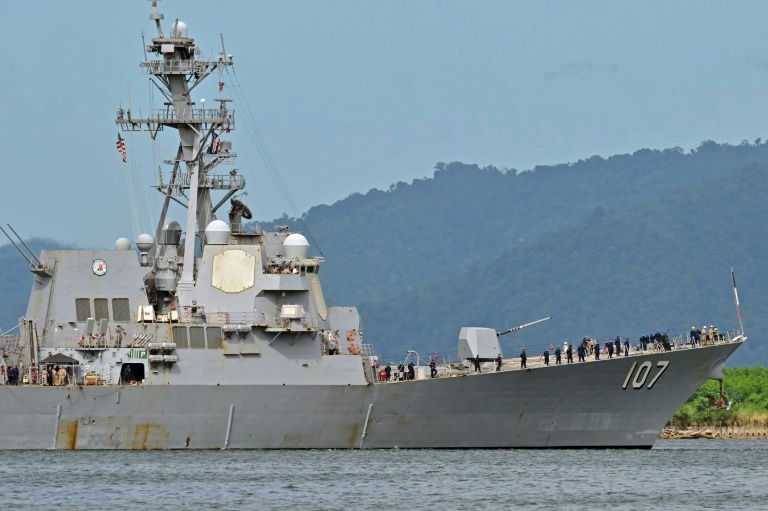
PORT OF SPAIN, Trinidad and Tobago – The recent arrival of a U.S. Navy warship in the tranquil waters of Trinidad and Tobago has sent subtle but unmistakable ripples across the Caribbean, underscoring the complex geopolitical currents just beyond the islands’ idyllic shores. While officially labeled a “logistical port call,” the presence of the USS Truxtun, an Arleigh Burke-class guided-missile destroyer, so close to the coast of Venezuela, is being closely watched as a strategic display of American engagement and military readiness in a region of growing importance.
The visit, which included personnel exchanges and community outreach events, was framed by both U.S. and Trinidadian officials as a routine demonstration of the long-standing partnership between the two nations. A statement from the U.S. Embassy in Port of Spain emphasized cooperation on shared priorities like “security, counter-trafficking operations, and disaster preparedness.”
However, the unspoken context of the visit looms large: the ongoing political and economic crisis in neighboring Venezuela. The arrival of a powerful symbol of American naval power a mere few hundred miles from Venezuelan territory is a move rich with strategic nuance.
A Message of Presence and Partnership
For the United States, port calls like this serve a dual purpose. On one hand, they are a tangible commitment to its regional partners. The Caribbean has long been a corridor for drug trafficking and other illicit activities, and the U.S. Southern Command (SOUTHCOM) regularly conducts operations with allied nations to combat these threats. The USS Truxtun’s visit reinforces this ongoing security cooperation.
“These engagements are vital for maintaining interoperability and building trust with our Caribbean partners,” said a U.S. defense official, speaking on background. “It’s about being present and working together to ensure a stable and secure region.”
For Trinidad and Tobago, the visit is a balancing act. The twin-island nation maintains diplomatic relations with Venezuela and has a history of energy sector collaboration. At the same time, it values its strong ties with the United States, particularly in the realm of security. Welcoming the warship is a way to reaffirm that relationship without necessarily endorsing a more confrontational U.S. stance toward Caracas.
The Venezuelan Elephant in the Room
Despite the official pleasantries, analysts agree that the proximity to Venezuela is the central, if unstated, element of this deployment. The South American nation, sitting just seven miles from Trinidad at its closest point, remains mired in a profound crisis under the rule of Nicolás Maduro.
The U.S. has led international efforts to pressure Maduro, imposing crippling economic sanctions and recognizing opposition leader Juan Guaidó as the legitimate president in 2019. While the pressure campaign has lost some steam recently, the U.S. military maintains a visible presence in the region as a deterrent and a signal of support for Venezuela’s democratic forces.
“A U.S. destroyer sailing this close to Venezuela is a clear signal to the Maduro regime,” said Dr. Celina Realuyo, a professor of international security at the National Defense University. “It reinforces that the United States is watching, it is engaged, and it has the capability to project power in its own hemisphere, especially as Venezuela continues its military relationship with actors like Russia and Iran.”
The Venezuelan government has historically viewed such U.S. naval movements with deep suspicion, often labeling them as “provocative” and a prelude to potential military intervention. While Caracas has remained relatively quiet about the Truxtun’s specific visit, its state media routinely condemns the U.S. “military presence” in Latin America and the Caribbean.
A Delicate Dance for the Caribbean
The event highlights the delicate position of Caribbean nations, caught between a traditional, powerful ally and a volatile, yet geographically and culturally close, neighbor. Many in the region are more immediately concerned with the spillover effects of Venezuela’s collapse, including a massive refugee crisis and increased insecurity.
For them, a U.S. presence can be seen as a stabilizing force, but one they must manage carefully to avoid being drawn into a broader geopolitical confrontation.
As the USS Truxtun departs the Port of Spain, its wake leaves behind more than just churned water. It leaves a reminder that in the Caribbean, diplomacy and security are inextricably linked to geography. A routine port call is never just a routine port call; it is a move on the strategic chessboard of the Americas, where the shadow of the crisis in Venezuela influences every play.