

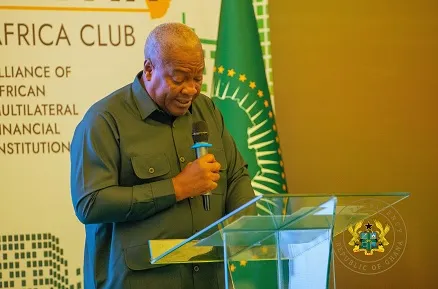
In a move that has stirred the pot of Ghana’s legal and political discourse, Franklin Cudjoe, the founding President of the policy think tank IMANI Africa, has publicly questioned the Ghana Bar Association’s (GBA) decision to exclude former President John Dramani Mahama from its recently held Annual General Conference.
The GBA’s conference, a premier event on the nation’s legal calendar, featured President Nana Addo Dankwa Akufo-Addo as its special guest of honor. The choice of speaker, while customary for a sitting president, has drawn scrutiny due to the event’s central theme: “Building Public Confidence in the Rule of Law; The Role of the Legal Profession.”
In a post on social media platform X (formerly Twitter), Franklin Cudjoe pointedly highlighted what he perceives as a significant oversight. He argued that for a balanced and thorough discussion on public confidence in the rule of law, the perspective of the main political opposition, embodied by former President Mahama, was not just valuable but necessary.
“If the theme for the Ghana Bar Association’s conference was ‘Building Public Confidence in the Rule of Law…’, then the obvious main speakers should have been the President [Akufo-Addo] and the Leader of the Opposition [Mahama],” Cudjoe stated.
He elaborated that Mahama’s inclusion would have provided a critical counterpoint, especially given the former President’s own strong and often critical views on the current state of Ghana’s judiciary and the perceived erosion of public trust under the Akufo-Addo administration.
The criticism taps into a long-standing narrative from the National Democratic Congress (NDC) and its leadership. John Mahama himself has been a vocal critic, having previously described the current judiciary as having a “perceived bias” and being “packed” with pro-government judges. He has repeatedly called for a radical reform of the legal system to restore its integrity.
Cudjoe’s query, therefore, raises a deeper question: can a conference genuinely tackle the crisis of confidence in the rule of law without actively engaging with the most prominent critics of that very system?
By featuring only the sitting President, critics argue the GBA risked presenting a one-sided narrative, potentially undermining the very confidence it sought to build. It frames the discussion within the status quo, without a robust challenge from the alternative viewpoint that represents nearly half of the Ghanaian electorate.
The GBA is yet to officially respond to this specific criticism. Traditionally, the Association has extended invitations to sitting presidents, and its choice of theme is often a broad reflection of national issues rather than a direct invitation for political debate.
However, in a deeply polarized political environment where the judiciary’s independence is constantly under public scrutiny, Cudjoe’s question resonates. It challenges professional bodies like the GBA to not only discuss inclusivity and confidence in theory but to also demonstrate it in practice through their choice of platforms and speakers.
Whether this omission was a simple adherence to protocol or a missed opportunity for a groundbreaking, balanced national dialogue remains a topic of fierce discussion. Franklin Cudjoe has undoubtedly framed the GBA’s conference not just by what was discussed, but by who was absent from the podium.