


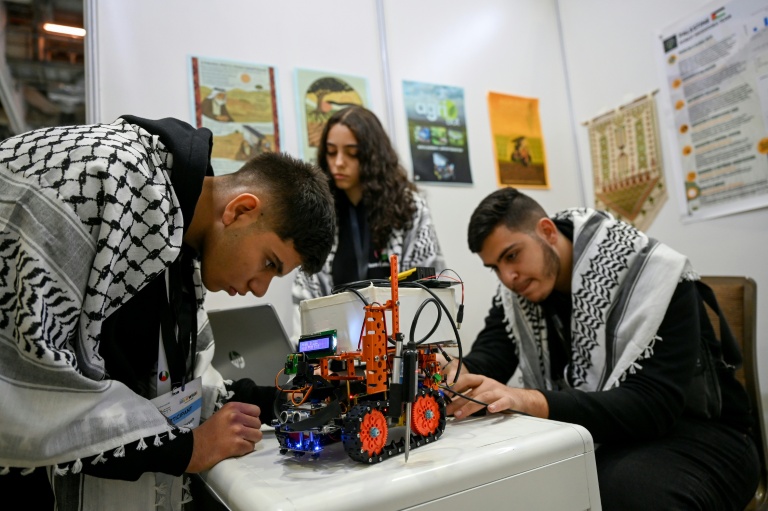
In a world where headlines from their homeland often speak of division and hardship, a team of Palestinian teenagers recently told a different story—one written in lines of code, powered by circuits, and dreamed into life on a global stage. At the prestigious FIRST Global Challenge, a robotics olympiad held in Singapore, these students from the West Bank and Gaza weren’t just competitors; they were ambassadors of ingenuity, proving that aspiration can flourish even in the most challenging environments.
The journey to Singapore was a victory in itself. For a team from Gaza, it meant navigating a labyrinth of permits and closures, their robot components subject to the same stringent restrictions as everything else entering the strip. For their peers in the West Bank, building a competitive robot meant sourcing parts through a fragmented supply chain, often relying on ingenuity to substitute or fabricate what they couldn’t easily acquire. Their practice space wasn’t a state-of-the-art lab but a classroom where persistence was their most valuable tool.
Yet, when they arrived in Singapore, the backdrop wasn’t the separation wall or the rubble of conflict, but the gleaming, futuristic skyline of a global tech hub. Surrounded by teams from over 190 countries, the universal language of science and technology took over. The event’s theme, “Carbon Capture,” tasked teams with designing robots to clean up a simulated environment—a mission that resonated deeply with youths from a region acutely aware of environmental and resource challenges.
“At home, we are often defined by the political situation,” said one 17-year-old team member from Ramallah. “But here, we are defined by our minds. We are programmers, engineers, and problem-solvers. When we are working on our robot with teams from the USA, India, or Brazil, we are just peers. There are no borders between our ideas.”
Their robot, a nimble machine designed to navigate a complex playing field, was a physical manifestation of their resilience. Every welded joint and every line of debugged code represented a triumph over adversity. While they may not have taken home the top prize, their success was measured in different metrics: the applause from the international crowd, the friendships forged over shared code, and the quiet confidence that grew with every alliance formed on the competition floor.
For these teens, the festival was more than a competition; it was a portal to a future they are determined to shape. They spoke not just of winning medals, but of one day building tech startups, advancing medical robotics, or creating sustainable solutions for their communities. They saw a world where their skills could be part of the solution, not just to technical problems, but to human ones.
The image of these Palestinian teenagers, collaborating with a team from a nation they may never have expected to meet, offered a powerful glimpse of an alternative reality. It was a testament to the fact that while politics may build walls, curiosity and a shared passion for innovation can build bridges.
As they packed their robot to return home, they carried back more than just hardware. They carried a renewed sense of possibility, the phone numbers of new international friends, and the unwavering belief that their dreams have a place on the world stage. Their story is a crucial reminder that talent is universal, even if opportunity is not. And in the determined glow of a screen in Singapore, the future, for a moment, looked brilliantly, hopefully, programmable.